
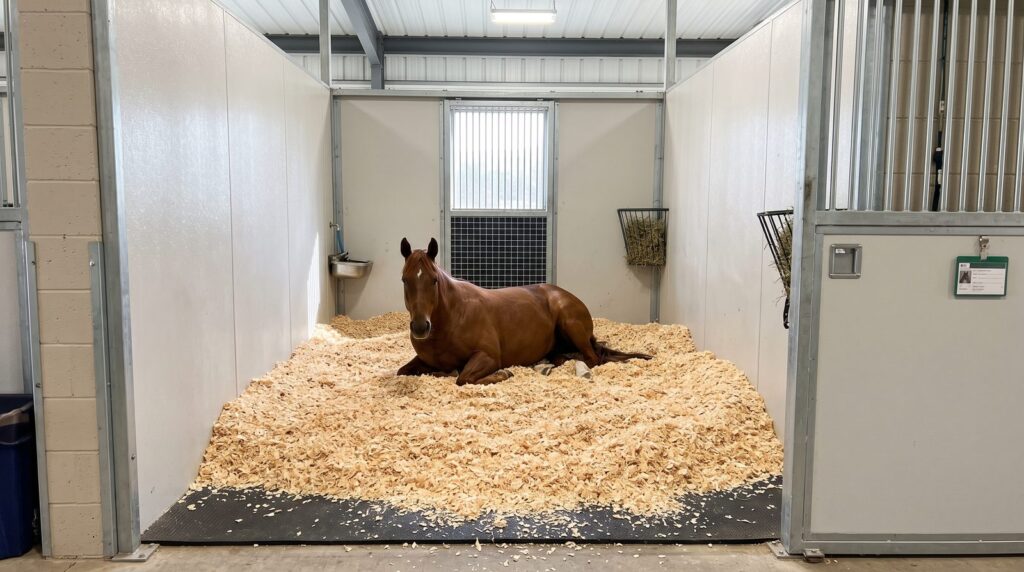
A hospital box is not just any stable. The horse in it has an open wound, has just had surgery, is recovering from colic or is going through a respiratory problem. Everything around that animal during its stay affects how it recovers, and the bedding is the surface it is in contact with 24 hours a day. That is why wood shavings for equine veterinary clinics have to meet standards an ordinary yard does not ask for.
At Visecorsa we have been supplying shavings to equestrian centres for more than 25 years, and more and more equine veterinary clinics ask us for wood shavings designed for in-patients: clean, dust-free, free of chemical treatments and with a supply that never fails. This is what they look for and why.
What wood shavings for equine veterinary clinics must deliver
A vet who runs in-patient boxes looks at four things. No dust, because a horse with compromised airways cannot be breathing fine particles. Clean material, with no splinters or coarse bark that could contaminate a wound or a bandage. Good absorption, so that urine and fluids are held in the bedding instead of pooling under the horse. And quick removal, because between one patient and the next the box is completely emptied and disinfected.
Our shavings are made from selected natural wood, planed and double screened to remove fine dust. We explain the process in detail in the article on respiratory health and dust-free shavings.
Post-operative care and wounds: what lies under the bandage
After surgery a horse spends many hours lying down. The bedding touches incisions, drains and bandages. Dusty shavings or irregular particles increase the risk of contaminating the area and make every dressing change harder.
With clean, soft shavings the bandage stays cleaner, the bedding is easy to remove around the affected area and the horse rests on a cushioned surface. Because it is natural wood without glues, varnishes or chemical treatments, there are no residues from the bedding that could come into contact with the wound.
Colic and recovery: a bed the horse wants to lie down on
A horse coming out of colic or a painful condition needs to lie down and get up many times. A thin, hard bed discourages it from resting, and straw bedding compacts and gets dirty very quickly.
We recommend a deep bed, 15 to 20 cm in in-patient boxes, with banks built up against the walls to cushion knocks if the horse rolls. Shavings regain their volume when turned over and stay comfortable throughout the stay. In our guide to wood shavings for horses we explain how to prepare the bed step by step.
Isolation boxes: changing all the bedding without hassle
In an isolation box, every discharge means removing all the bedding and disinfecting. With shavings it is quick: they come out with a shovel or wheelbarrow, they do not tangle like straw and they leave the floor clear for the disinfectant.
Used shavings are biodegradable and are handled as organic waste according to the clinic’s own protocol.
A supply of wood shavings for equine veterinary clinics you can rely on
A clinic cannot run out of bedding on a Friday afternoon with two admissions under way. That is why we work with clinics in a simple way:
- Heat-sealed bales of around 15 kg, easy to store and for staff to carry by hand. They arrive on pallets of 21 or 24 bales on a lorry with a tail lift, so unloading is not your job.
- Regular replenishment agreed according to the number of boxes and average occupancy. We do ask for a phone call to confirm each delivery before we prepare it. In summer, with the heat, consumption drops, and we would rather agree the date with you than have the order arrive earlier or later than you need it.
- A small reserve at the clinic. Shavings keep for months if stored dry and under cover, so you can hold stock without risk.
We deliver in Galicia, Castile and León, Castile-La Mancha, Catalonia and Portugal. You will find the details in our article on wood shavings by the pallet.
Frequently asked questions about wood shavings for equine veterinary clinics
They are the bedding vets usually recommend in these cases, as long as the shavings are dust-extracted like ours. In severe cases it is best combined with good ventilation and careful hay management.
With clean, soft, dust-free shavings the risk is minimal. If the wound is in an area in direct contact with the floor, the usual practice is to keep a protective bandage on and remove soiled bedding more often.
Occasionally eating natural wood shavings with no chemical treatment does not usually cause problems. If the horse eats them repeatedly, it is a sign worth looking into.
Yes. We sell in small and large quantities, from a clinic with two in-patient boxes to a referral hospital.
Let’s talk about your in-patient boxes
If you run or work at an equine veterinary clinic and want bedding that meets your protocols, tell us how many boxes you have and your usual occupancy. We will prepare a proposal with a regular supply and no surprises.
